
A provider's record is a document somebody made.
A strategy card shows a return, an age and a small curve. This site takes 20 real cards from cTrader's public pages, names them in the order they were created, and reads each as a constructed document: when it began, what fees do to a result, what a monthly bar hides that a curve shows, how many records are the same instrument, and which rules are the reader's own. Read on 6 November 2026. It ranks nothing and does not say whether to copy anyone.
Five questions to put to a record
1How was it built?Creation dates from 6 February 2023 to 18 September 2026, providers with more than one card, and what the help pages say a record contains.2What do fees do to it?The help page's own example taken from gross to net, then the same allocation at the printed caps.3Bars or curve?Why a monthly bar and a 29-day curve can describe one account differently, with every card's curve in a table.4One instrument?15 of the 20 cards trade gold. What that makes of 20 records, and the cards with other symbols.5Whose rules?The controls the help pages give the follower, written as rules with numbers, and the limits the pages put on each.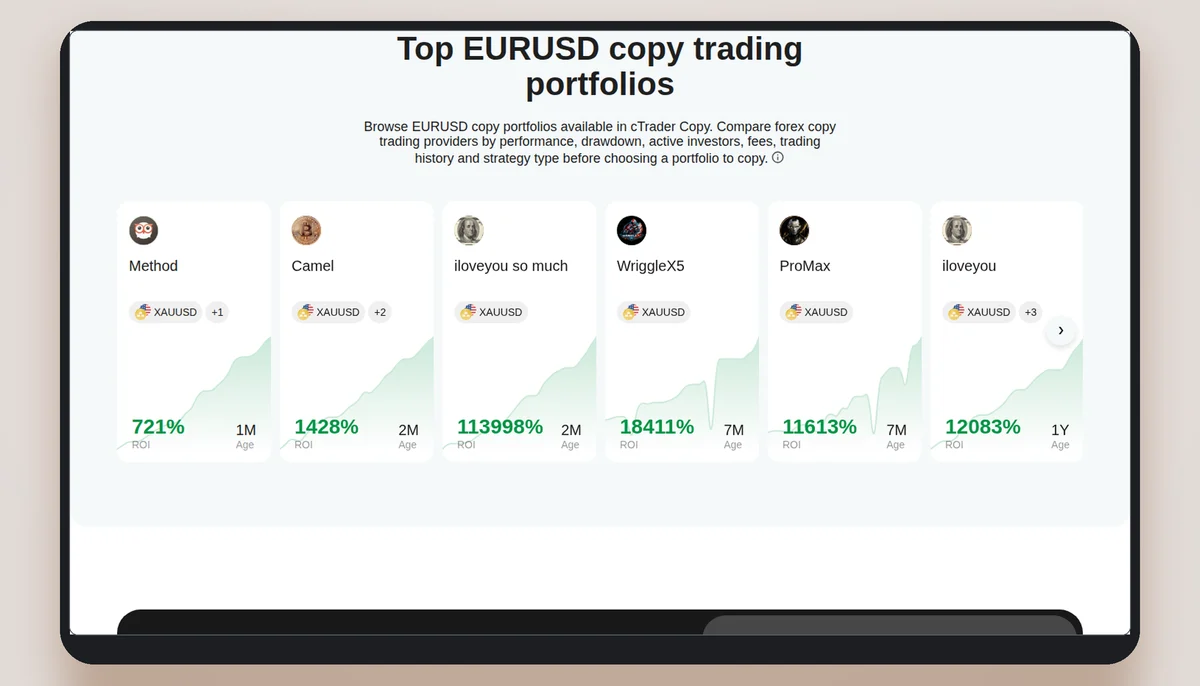
What this site is, and the one thing it does
Provider Record Kenya reads strategy cards that cTrader Copy shows on its public pages and treats each as a document that somebody made. It names 20 cards in the order they were created, counts what they print, and sets beside them what the cTrader help pages define. The cards are those of the gold, bitcoin and euro symbol pages, which list the same 20; the help pages are four of cTrader Copy's; the lists of the Capital Markets Authority of Kenya are its register, its caution page and its public notices. The latest reading was 6 November 2026.
Nothing here is a ranking, a recommendation or a promise. Where a page was silent, this site says that it was silent.
What a record is
A record is the history of one trading account from the day it began, as summarised by a platform. It can be shown as a percentage, as a curve, or as bars by month. It contains the provider's own deposits and withdrawals, it starts when the account or the strategy starts, and it is measured before the fees that a follower pays. A follower does not receive it: the follower's account has its own history, which begins on the day the follower starts copying.
How the records were built, from the dates
The oldest card was created 1,369 days before the reading and the newest 49. 12 of 20 are younger than a year and 4 younger than 100 days. Two nicknames hold several cards: one holds 4, all gold, created on four dates, and another holds two. Two further nicknames differ by one character. A creation date dates the strategy; what the provider did before it is not on the cards. The first page has the whole list, in creation order.
What fees do, on the help page's own numbers
On a USD 1,000 allocation with a USD 700 profit, a 10% performance fee takes USD 70 and a 5% management fee takes USD 50 for a year, so USD 580 is left of the profit if both apply to the same year. At the printed ceilings, 40% and 10%, the same profit is cut to USD 320. Those are arithmetic on a worked example and on ceilings; no card on the list shows its fees.
What a bar leaves out
The help pages define one chart that draws a return for each month and others that draw a line through time. A bar is one number; two accounts can end a month on the same bar after very different paths. The 29-day curves of the 20 cards show it on real data: 15 ended the window above zero, 5 below, and the largest fall inside any curve is 36.79 points. 2 cards ended above zero after falling 10 points or more. The third page has every curve.
How many records are one instrument
15 of the 20 cards list gold, and 8 trade nothing else. 11 cards trade a single symbol. The longest list has 10 symbols. In a set where 15 of 20 records include one price, that part is one price seen several times from different entry points. The fourth page counts the symbols as the cards spell them and sets the gold cards side by side.
Rules the reader holds
The platform's controls (an equity stop loss, an allocation, a stop, filters by age and fees) all take numbers. The fifth page writes each as a rule and quotes what the pages say limits it. The stop loss is not a guaranteed price. A minimum investment is also a floor on withdrawals, and on the cards the minimum runs from USD 100 to USD 50,000.
Who is behind a nickname
The register of the Capital Markets Authority held 158 rows on 5 November 2026; its caution page dated 11 September 2026 named 15. None of the 20 nicknames or strategy names equals a name on either list, which says little, because a nickname is not a legal name. No CMA statement on copy trading was found among the lists read, and the press-release list could not be opened (HTTP 502). This site states no position of the CMA on copy trading.
What the list does not say about itself
The same 20 cards appear on the gold, the bitcoin and the euro page, so the list is not chosen by symbol. The pages call them featured strategies and do not say how they were picked, or whether the choice changes from day to day. Each of the three pages carries the sentence "Past performance does not guarantee future results." That sentence is the platform's own, printed beside the cards, and this site repeats it because it is the only statement about the cards' figures that the platform itself makes on those pages. A list of 20 cards is a sample of unknown origin, and nothing on this site treats it as the market.
What a printed return is, and is not
The return on a card is a number with a percent sign and an age label next to it, such as 2M or 3Y. The age agrees with the creation date. The period over which the return was earned is not printed, and neither is the base it is a percentage of. The card two months old and the card three years old stand in the same column, and the help pages say the ROI chart relates a return to the balance at the beginning of the period. Without the period and the base, two printed returns cannot be set against each other, and the third page tabulates them only to show that difference.
Where the sources end
Four things are outside what was read. The fees of any one strategy sit on a button inside the application. The page that explains how the platform calculates ROI is a help page that was not among the four read. The trade lists, the drawdown statistics and the provider pages need a login. And no statement of the Capital Markets Authority about copy trading was found, with its press-release list unreadable on the day. Each page marks these gaps where they matter, so a reader can tell a sentence that rests on a page from a question that has no page behind it.
How the six pages fit together
The first page asks when a record began and who is behind the nickname. The second takes the fees off a result. The third sets bars against curves and puts every card's curve in a table. The fourth counts how many cards are one instrument. The fifth turns the platform's controls into rules with numbers. The sixth compares names with the register. Read together they are one reading of a card: its making, its cost, its shape, its concentration, the reader's own limits and the person behind it.
Questions to put to a card before reading its number
When was this account created, and is this strategy its first? Does the figure count the provider's own deposits? Is it before or after the investor's fees? Over what period? What does the equity chart show that the bars do not? How many of the cards in front of me are the same instrument? What would I have to write down as a stop, and what does the platform say about that stop? Who is the person, and where would a complaint go? Each question has a place in the pages that follow, and some have no answer on any public page.
Terms used here
Strategy: all the trading actions a provider executes on a live account, offered for copying. Record: the history of that account as a platform summarises it. Return as printed: the figure on a card, whose period the card does not state. Curve: a line through time. Bar: one value for a month. Drawdown: a fall from a high point to a later low. Equity: balance with open profit and loss. Equity stop loss: the follower's level at which a copy ends. High-water mark: the highest value reached, above which a performance fee is charged.
When the readings were taken
The cTrader pages were saved on 6 November 2026, one request at a time. The CMA register was read on 5 November 2026; the caution and notice pages on 6 November 2026. A card list changes: strategies are added, and a strategy's provider can stop it. The date beside a figure is what makes it checkable. A reader who opens the same pages later may see other cards, other orders and other figures, and the saved copies on which every count here rests are kept so that a count can be repeated by anyone who has them.
How a figure on this site is checked
A second script recounts the cards, their dates, minimums and curve falls from the saved files by another route and compares them with the figures used. Defects planted on purpose were caught each time. The CMA row counts are asserted against the counts stored at reading time. The check proves that figures were copied correctly. It does not prove that a platform's or a regulator's page is right.
Six pages, one document
- 01How a record is built20 cards in creation order, the providers who have several, and the fields of a strategy page.
- 02Fee dragGross to net on the help page's example, and the same allocation at the printed caps.
- 03Bars against the curveWhat the monthly chart and the equity chart are defined to show, and each card's 29-day curve.
- 04One instrument, one storyCards counted by symbol, with the gold cards set side by side.
- 05Your own rulesStop loss, minimum, fees and age as rules with numbers, and what the pages say limits each.
- 06A nickname and the registerCards compared by name with the CMA register of 158 rows and its 15-name caution page.
The broker this site links to
The site links to FxPro, which cTrader's list marks as a copy-enabled broker. A record is the provider's; the account a copy runs on is the follower's, and its result is a different document. Whether the copy service is open to a resident of Kenya is for FxPro to say.